Why Does a Swimming Pool Smell Like… a Swimming Pool?
It’s beginning to feel like summer here in San Francisco, which means neighborhood pools are filling up with kids, families, and determined lap swimmers.
I recently stopped by my local YMCA pool and was immediately hit by that unmistakable “chlorine” smell. Within seconds, I was transported back to childhood: birthday pool parties, slices of pizza, orange soda, wrinkled fingertips, and bloodshot eyes after spending hours underwater pretending to be a fish.
That wave of nostalgia got me wondering: why do swimming pools smell the way they do?
The surprising answer? A strong-smelling pool isn’t actually a sign that there’s lots of chlorine. It’s often a sign that the chlorine has already reacted with contaminants brought in by swimmers.
The chemistry happening in every pool
Pools are disinfected with chlorine because it forms hypochlorous acid (HOCl) in water, a powerful sanitizer that destroys bacteria, viruses, and many other harmful microbes (1).
But chlorine doesn’t just react with germs.
It also reacts with sweat, skin oils, cosmetics, dirt, and nitrogen-containing compounds found in urine, such as urea, ammonia, and uric acid. These chemical reactions produce a family of compounds known as disinfection byproducts (DBPs) (2-3).
One group of these byproducts, called chloramines, is largely responsible for the familiar “pool smell.”
In short: The stronger the pool smells, the more chlorine has already reacted with contaminants, not necessarily the more chlorine that’s present. A well-maintained pool with the correct amount of free chlorine should actually have very little odor.
Why do pools make your eyes sting?
One chloramine in particular trichloramine (NCl₃) is especially irritating.
It readily escapes from the water into the air hovering just above the pool’s surface, especially in indoor pools with poor ventilation. Once airborne, it can irritate your eyes, nose, throat, and lungs, causing the familiar burning eyes, coughing, or scratchy throat that many swimmers associate with chlorine.
Another compound, cyanogen chloride (CNCl), can also form when chlorine reacts with uric acid. Although typically present at much lower concentrations, it is a toxic volatile compound that contributes to the complex chemistry of heavily used pools.
What you’re really breathing
Because chloramines easily evaporate into the air, they’re most noticeable just above the water’s surface.
That’s why competitive swimmers, lifeguards, and pool staff, can experience symptoms such as:
Burning, itchy, or red eyes
Coughing or throat irritation
Runny nose
Wheezing or worsening asthma symptoms
Dry, itchy skin after swimming
Fortunately, properly maintained pools with good ventilation greatly reduce these exposures.
The easiest way to improve pool chemistry
The good news is that preventing chloramines is surprisingly simple.
Before jumping in:
Take a quick shower. Even a one-minute rinse removes much of the sweat, body oils, dirt, and cosmetics that react with chlorine.
Use the restroom first. Chlorine isn’t a magic eraser—it doesn’t instantly make urine disappear. Instead, it spends its energy reacting with it.
Take regular bathroom breaks for children. Young swimmers are much more likely to have accidents in the water.
These simple habits don’t just make the pool smell better—they also leave more “free chlorine” available to do its real job: keeping the water safe by killing germs.
The next time you smell “chlorine”…
That sharp scent isn’t necessarily telling you the pool is clean.
It’s actually evidence of chemistry in action: chlorine has been busy reacting with everything swimmers brought into the water.
So the next time you head out for a summertime swim, grab your goggles, enjoy the nostalgia and take a minute to rinse off before you dive in. Your fellow swimmers (and your eyes) will thank you.
References:
"Water Chemistry." SF.gov, City and County of San Francisco, www.sf.gov/water-chemistry. Accessed 29 July 2026.
What's in the pool? A comprehensive identification of disinfection by-products and assessment of mutagenicity of chlorinated and brominated swimming pool water. Environ. Health Perspect.2010, 118 (11), 1523–1530. DOI: 10.1289/ehp.1001965
Disinfection by-products in indoor swimming pools: A critical review to prioritize commonly occurring species and influencing factors. Journal of Hazardous Materials, 2025, 495, 138739
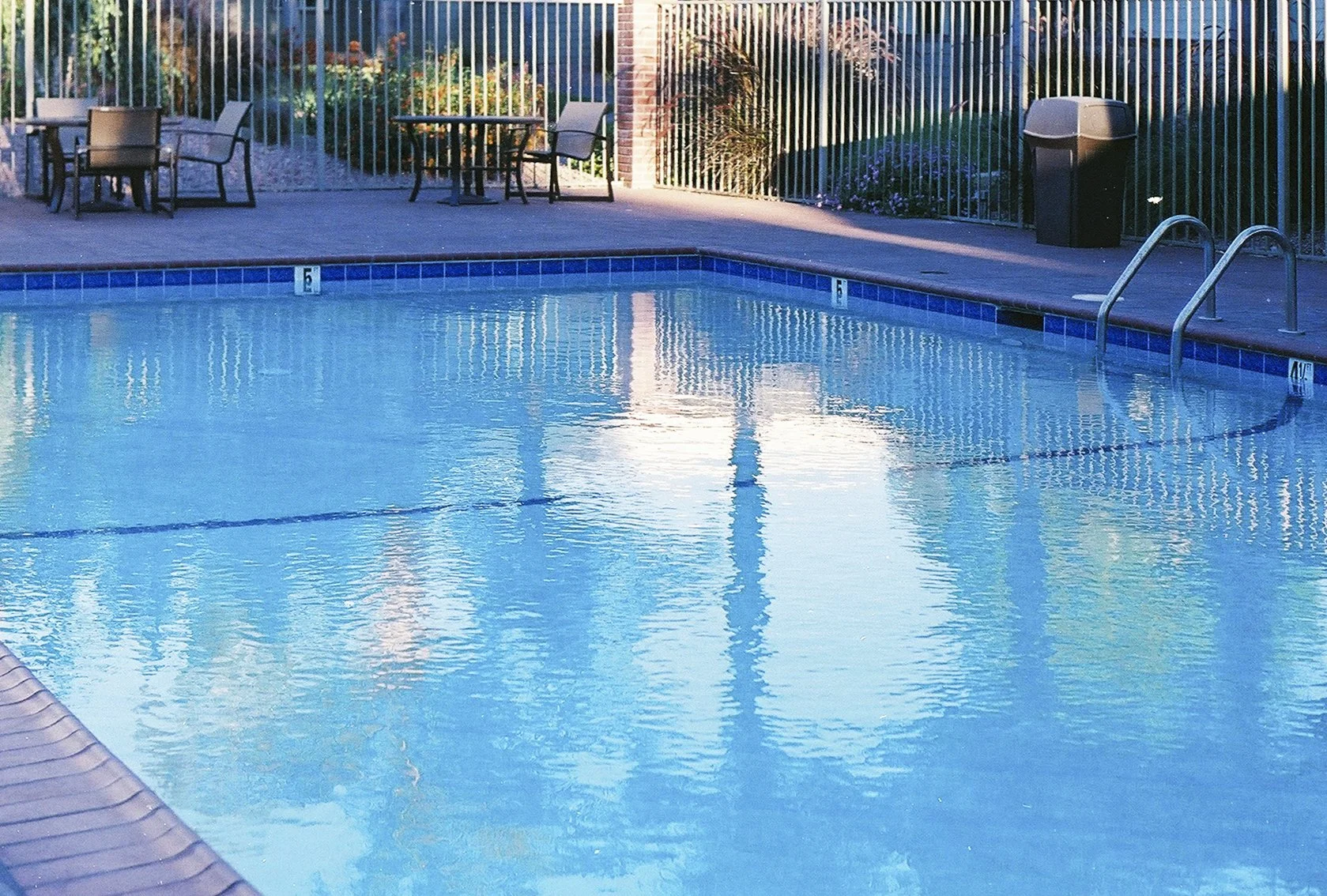
Photo By Andrea d’Aquino / Taken on 35 mm Film
